UK CARBON ACCOUNTING AND GHG BASELINING

GHG emissions calculations and carbon reporting that hold up to scrutiny.

Wylde Connections measures your complete Scope 1, 2 and 3 emissions to the GHG Protocol, gives you an audit-ready footprint, and turns it into a clear reduction plan. Whether you need a Carbon Reduction Plan for a tender, SECR or ESOS compliance, or verified data for a customer, you get a report that stand up to scrutiny from your board, your buyers and your auditors.

No payment details required. No obligation.

What brings you here?
01
Scope 3

A customer has asked for your Scope 3 data

What this means

Corporate procurement teams are asking their whole supply base for emissions data. Most SMEs have never calculated theirs and are not sure what the question even relates to. Scope 3 is the emissions across your value chain, and it is usually the largest part of any footprint.

What we give you

A full baseline that includes the Scope 3 detail your customer is asking for, in a form you can hand straight back, plus help responding to their questionnaire so you stay in the running.

Best for: SME MDs, operations and sales leads on the supplier side; sustainability and procurement directors on the corporate side.

Talk to us about supplier carbon data

If you are the one asking (Tier-1 corporates)

If you are the corporate sending those questionnaires, the hardest part of your own footprint is the Scope 3 sitting in your supply chain. Through the Enveglas ESG Diagnostic you can run the same structured assessment across your whole supplier base and get comparable, audit-ready data back. Explore Enveglas for supply chains

02
SECRESOS Phase 4

SECR or ESOS applies to you, and the dates are fixed

SECR

Streamlined Energy and Carbon Reporting requires large UK companies, quoted companies and LLPs to report energy use, carbon emissions and an intensity ratio in their annual accounts. A company generally qualifies if it meets at least two of: 250 or more employees, turnover above £36 million, or a balance sheet total above £18 million.

ESOS Phase 4

The Energy Savings Opportunity Scheme requires large UK organisations to carry out energy audits every four years. An organisation qualifies if it employs 250 or more people, or has turnover above £44 million and a balance sheet total above £38 million.

Qualification date31 December 2026
Compliance deadline5 December 2027

What we give you

SECR-ready figures for your Companies House submission and an ESOS-aligned position, all calculated to the GHG Protocol so they hold up with auditors and regulators.

Best for: finance directors, company secretaries, sustainability and facilities leads.

Check whether SECR or ESOS applies to you
03
PPN 006

You are bidding, and the tender wants a Carbon Reduction Plan

What this means

Under PPN 006 (formerly PPN 06/21), a compliant Carbon Reduction Plan is a condition of bidding for many UK central government contracts above £5 million a year, and the requirement is spreading to the NHS, local authorities and framework applications. A compliant plan must state a base year, cover Scope 1, Scope 2 and at least five Scope 3 categories, and confirm a commitment to Net Zero by 2050.

Why you cannot shortcut it

You cannot write a compliant plan without first measuring your emissions. The baseline is the foundation; the plan is built on it.

What we give you

A full Scope 1, 2 and 3 baseline to the GHG Protocol, and a Carbon Reduction Plan structured to the PPN 006 Technical Standard, ready to attach to your bid and stand up to scrutiny.

Best for: MDs, operations directors, bid and quality leads working to a submission deadline.

Talk to us about your tender

The one rule that ties it together

Whatever brought you here, it starts with one full baseline

We always measure a complete Scope 1, 2 and 3 footprint.

Scope 3, the emissions across your value chain, is usually around 90% of a footprint and the part that customers, tenders and PPN 006 Carbon Reduction Plans ask for. A figure that leaves it out is neither complete nor defensible, and you would only have to redo it the moment Scope 3 is requested. Measuring all three from the start gives you a baseline you can rely on.

Human-led, not algorithm-led. Built for UK compliance. A baseline that becomes a plan, not just data on a spreadsheet.

Book your FREE Demo

Understanding Carbon Accounting…

What is carbon accounting and a GHG emissions baseline?
Carbon accounting is the process of measuring the greenhouse gas (GHG) emissions a business is responsible for, expressed in tonnes of carbon dioxide equivalent (CO2e). A GHG emissions baseline is the first full measurement, taken for a chosen base year, against which all future progress is tracked. Wylde Connections is a UK-based sustainability consultancy that calculates emissions across Scope 1, 2 and 3 using the GHG Protocol and turns the baseline into a costed reduction plan.
What is the difference between Scope 1, 2 and 3?
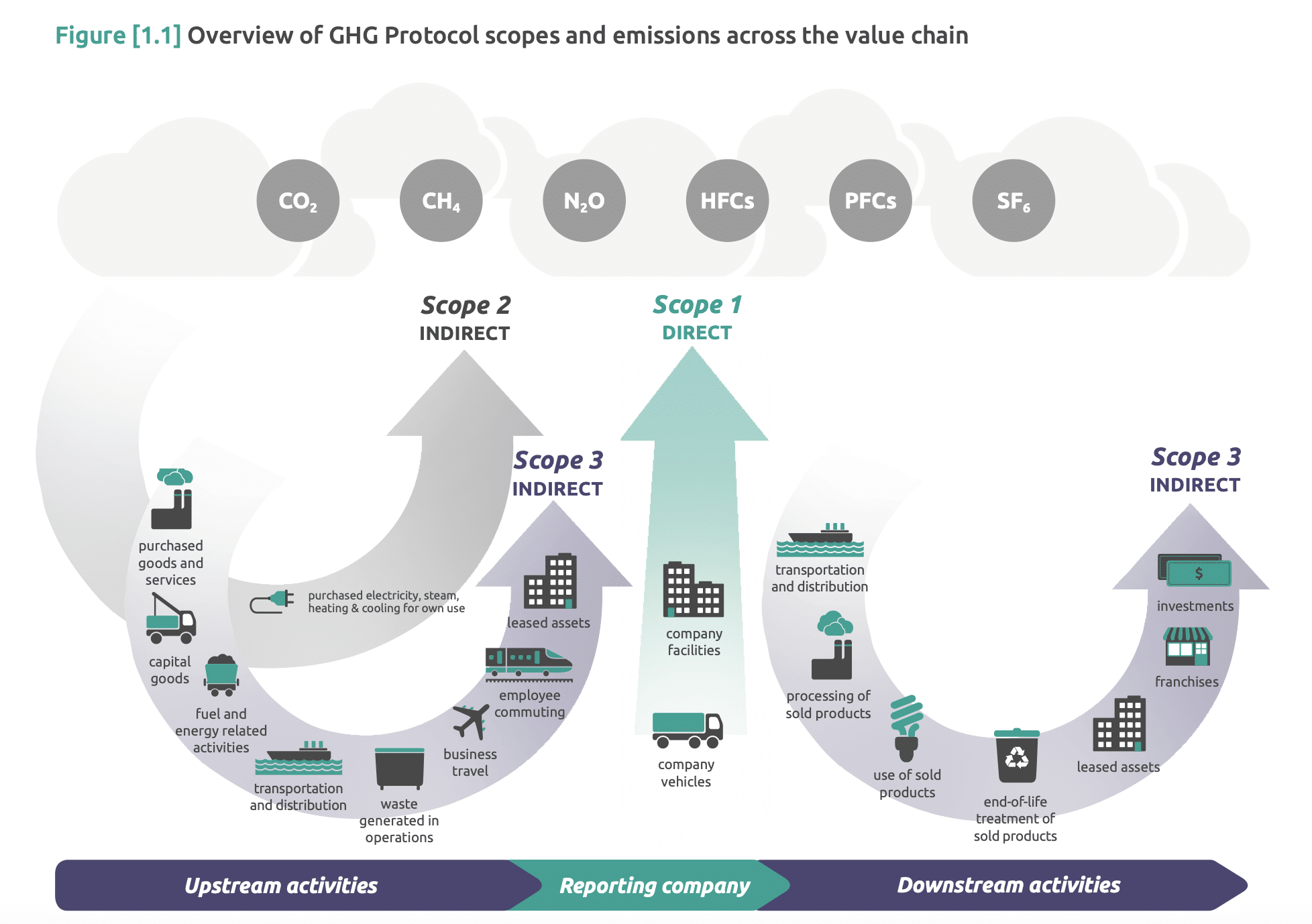
Scope 1 is direct emissions from sources you own or control, such as gas heating and company vehicles. Scope 2 is indirect emissions from the energy you buy, mainly electricity. Scope 3 is all other indirect emissions across your value chain, including purchased goods and services, business travel, commuting, waste and transport. Scope 3 is usually the largest part of a footprint, often around 90%.
What is the GHG Protocol?
The GHG Protocol is the most widely used global standard for measuring and reporting corporate greenhouse gas emissions. It sets the rules for organisational boundaries, the three scopes, and how emissions are calculated using activity data and emission factors. SECR, ESOS and PPN 006 Carbon Reduction Plans all expect emissions to be calculated in line with it.
Footprint or reporting, what is the difference?
A carbon footprint is the total emissions figure for a business, product or activity. Carbon reporting is the structured disclosure of that footprint to a recognised standard or scheme, such as SECR, a Carbon Reduction Plan or a customer questionnaire. Measuring your footprint is the foundation; reporting it correctly, to the right framework, is what wins contracts and meets compliance.

Our Carbon Accounting Services

What you get…

Z

A Complete GHG Emissions Baseline

A scored, audit-ready measurement of your full Scope 1, 2 and 3 footprint in tonnes CO2e, calculated to the GHG Protocol against a defined base year. Always all three scopes, never a partial figure.

A Compliance and Reporting Check

Your business mapped against the schemes that apply to you: SECR, ESOS, TCFD-aligned disclosure, and PPN 006 Carbon Reduction Plan requirements. Clear duties. Clear deadlines.

Intensity Ratios and Emissions KPIs

The intensity ratios SECR expects (emissions per unit of turnover, per employee or per square metre) plus the KPIs to track quarterly, built around your sector and size.

A Carbon Reduction Strategy and Plan

A costed reduction plan with a base year and latest reporting year, science-aligned targets, and a clear roadmap of actions with named owners. Where you need it, structured to meet the PPN 006 Technical Standard for tenders.

A Consultancy Session with our team

A walkthrough with an accredited Wylde sustainability consultant to talk through the numbers, agree priorities and plan the first 90 days.

How it works…

1. FREE Consultation and Demo
Start with a free, no-obligation Discovery Call. We learn your goals and any regulatory duties (SECR, ESOS, PPN 006, customer requests), agree the scope of the work, and explain how we will help.
2. Scoping and Data Collection
We define your organisational boundary and the scopes to be measured, then guide you in gathering and verifying the data. We work with what you have, structured or imperfect.
3. Emissions Calculation
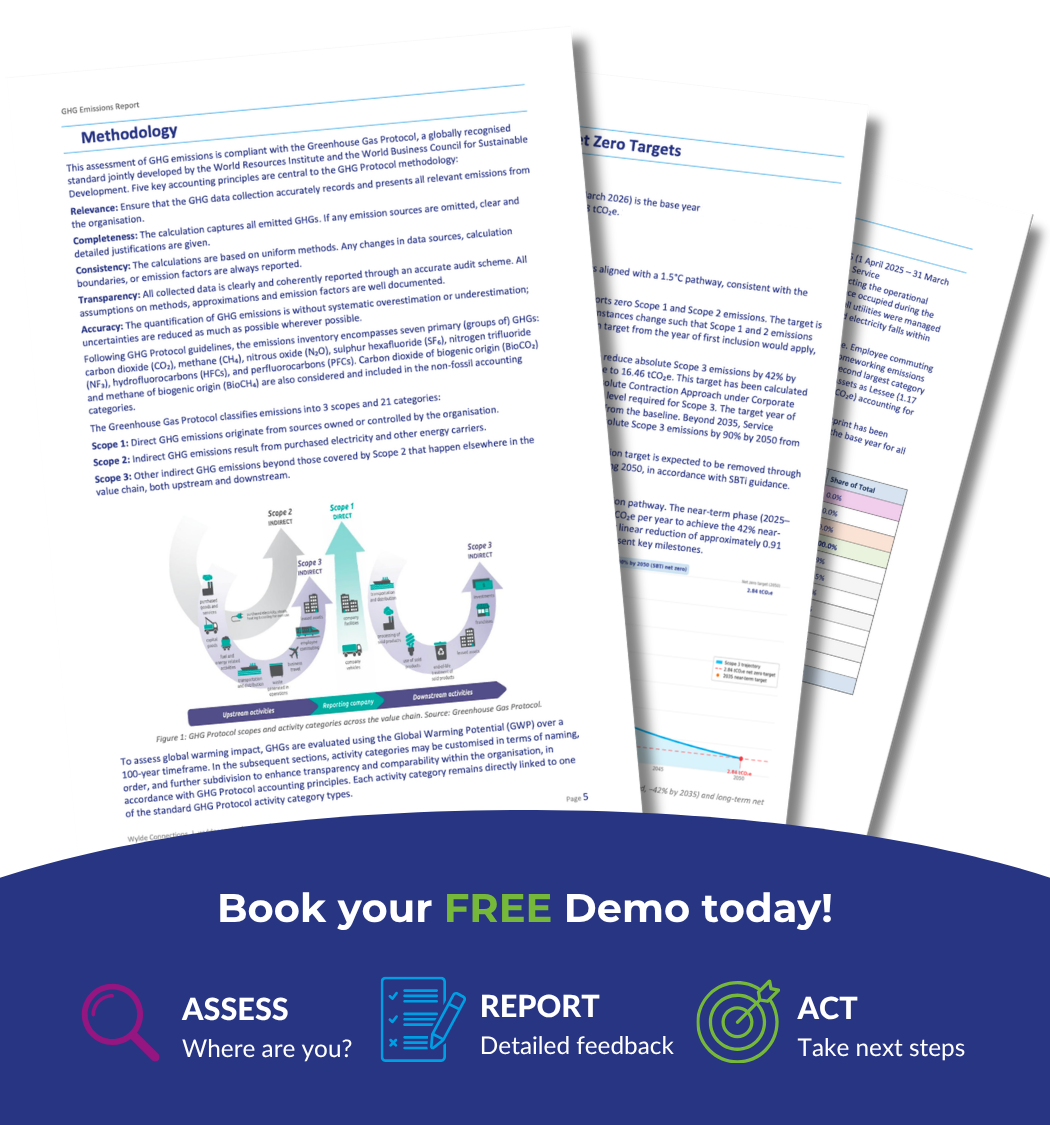
We calculate your Scope 1, 2 and 3 emissions to the GHG Protocol, producing an audit-ready report with intensity ratios and a clear breakdown of where your emissions sit.
4. Reporting and Compliance
We turn your emissions calculations into the report you need: SECR-ready figures for Companies House, an ESOS-aligned position, or a Carbon Reduction Plan structured to the PPN 006 Technical Standard for tenders.
5. Reduction Strategy and Ongoing Support
We build a robust action plan with targets, milestones and named owners, then support implementation with progress reviews and updates as regulations change.

Who we calculate emissions for…

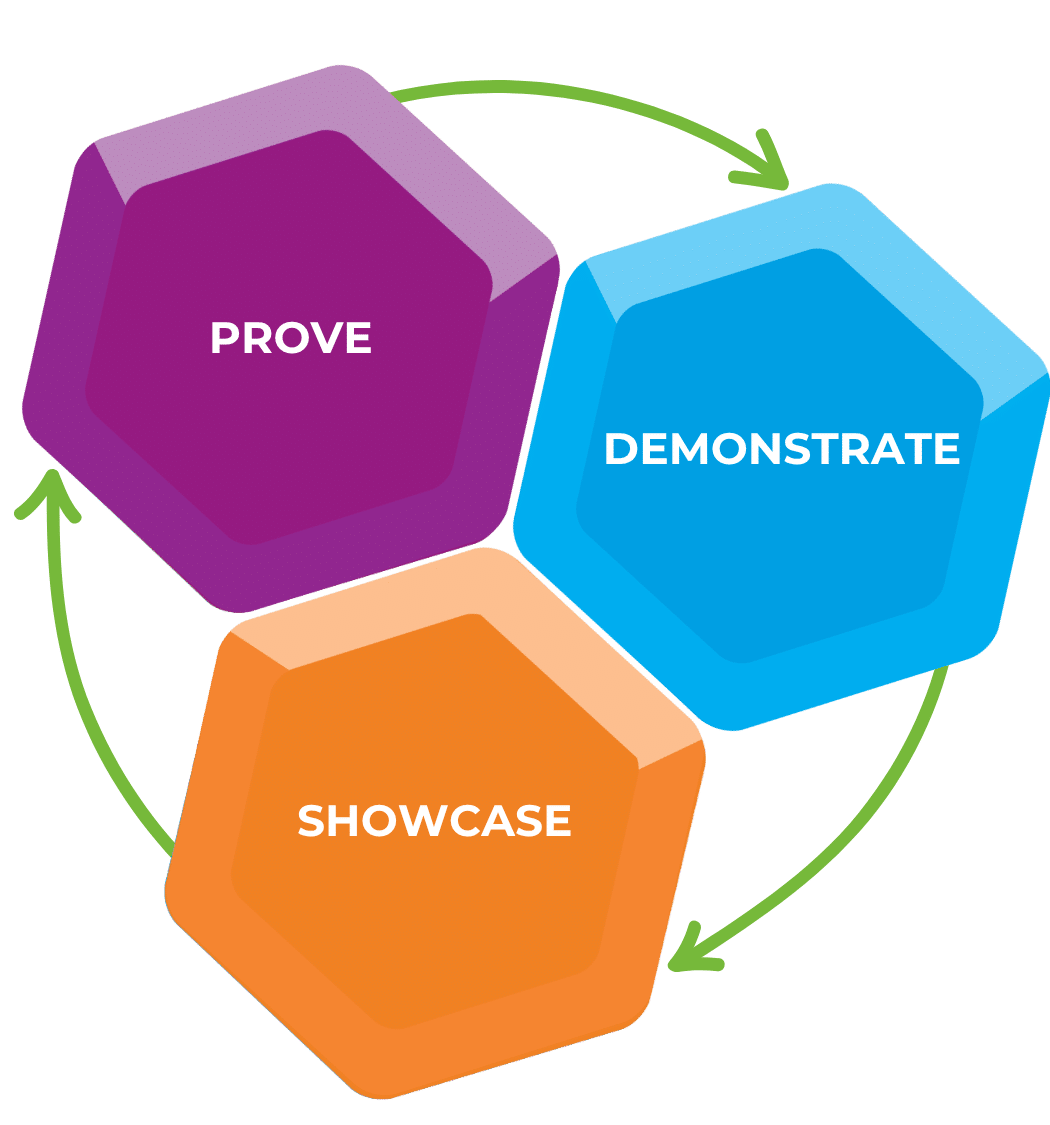
PROVE

Large companies with compliance duties.
If SECR, ESOS or TCFD-aligned disclosure applies to you, we deliver accurate, audit-ready figures and the intensity ratios you need to report, on time and to standard.

DEMONSTRATE

SMEs answering tenders and customer requests.
If a tender or a customer is asking for a Carbon Reduction Plan or Scope 3 data, we give you a baseline, a compliant plan and the evidence to stay in the running.

SHOWCASE

Businesses acting ahead of pressure.
If you want to lead rather than wait, we baseline your emissions, set credible targets and build the reduction roadmap to back up your claims and avoid greenwashing risk

Simple Banded Pricing, Tailored to Your Business

Find your band

Answer two quick questions and we will show your likely band.
Every band is a complete Scope 1, 2 and 3 baseline.

1How is your business set up?
2Roughly how many employees?

Your likely band

Book a free Discovery Call

All prices exclude VAT.

Band 1

Smaller, single-site service-based businesses with a straightforward value chain (up to around 25 employees). Your complete Scope 1, 2 and 3 emissions calculation, report and reduction plan.

Band 2

Established SMEs with one to a few sites, product or service led (around 25 to 100 employees). As Band 1, with a deeper data review and a fuller Scope 3 analysis.

Band 3

Larger, multi-site, manufacturing or group structures with deep Scope 3 (100+ employees or group consolidation). As Band 2, with multi-site or group consolidation and an expanded Scope 3 inventory.

Every band includes:

N

A Scoping Session

N
Data-gathering templates and support
N
A full Scope 1, 2 and 3 calculation
N
An audit-ready report with intensity ratios
N

A Carbon Reduction Plan with named owners

N
A consultancy session to review your report
N
A Carbon+Alt+Delete software licence for ongoing tracking

Corporate Data Across Your Supply Chain

One consistent approach to the emissions data you need from your suppliers.
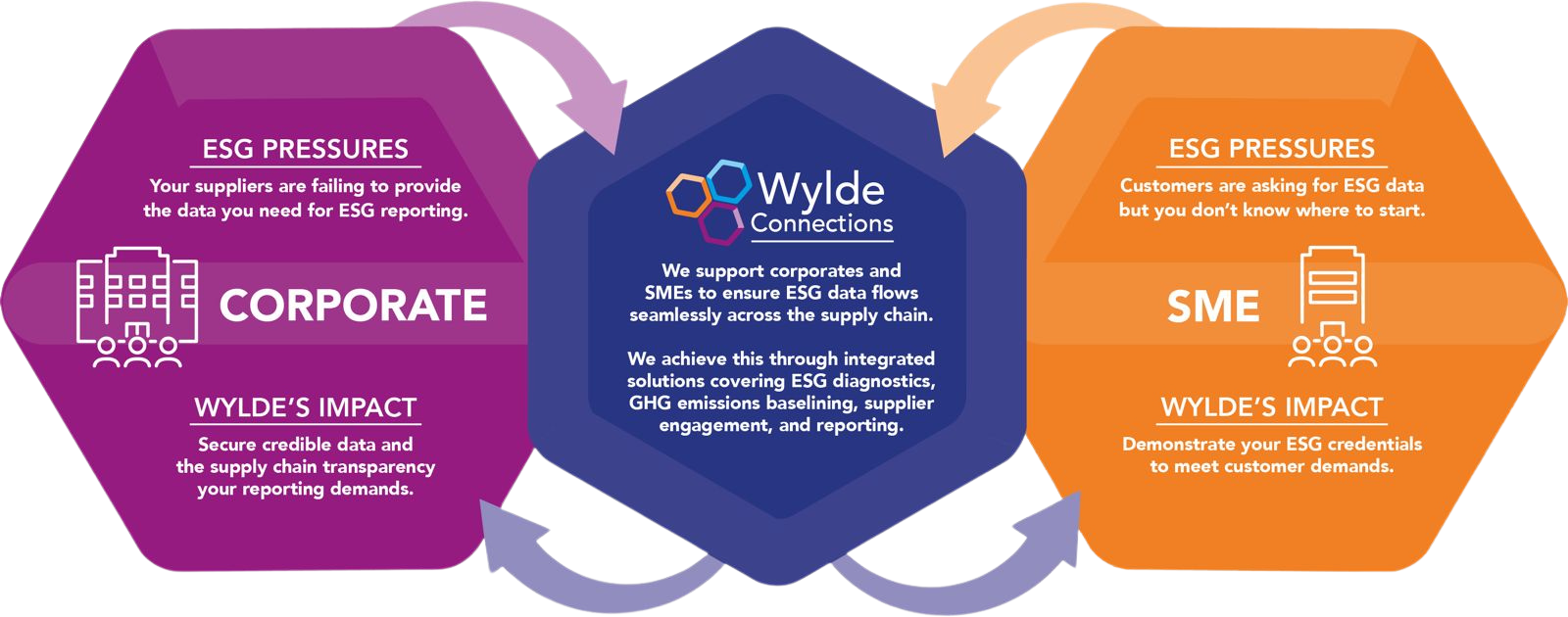
If you are a Tier-1 corporate, the hardest part of your own footprint is Scope 3: the emissions sitting in your supply chain. We help you collect comparable, audit-ready data from your suppliers, and through the Enveglas ESG Diagnostic you can run the same structured assessment across your whole supplier base.
How Enveglas ESG Diagnostic Tool helps corporates and supply chains

We work closely with corporate partners to:

  • Tailor data collection to your sector and reporting requirements.

  • Support supplier onboarding and engagement to encourage participation.

  • Align data collection with CSRD, SECR, SBTi and Scope 3 measurement frameworks.

  • Help embed the findings into your ESG and reduction action plans.

Contact us to explore licensing options and corporate support packages.

Not ready for a full report? Start here, for FREE…

You do not have to commit to a full report to make a start.

Use our free tools to understand where you stand, then talk to us when you are ready.
Enveglas ESG Progress Checker report sample

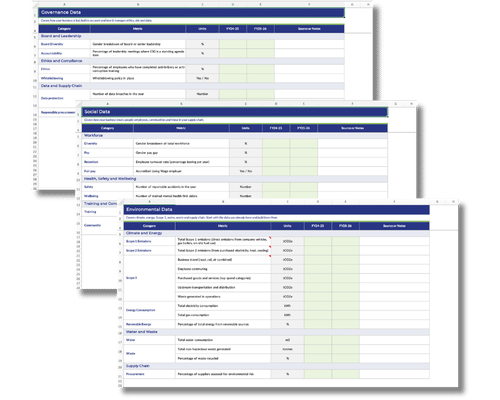
ESG Data Collection Starter Template

Z

A ready-to-use Excel workbook covering the key ESG metrics SMEs are most often asked for

Z

Environmental, Social and Governance tabs, including Scope 1, 2 and basic Scope 3, with a glossary that explains every term

Z

Space to record two years side by side, so you track year-on-year progress from day one

Z

A clear next step into a full Scope 3 baseline and the Enveglas ESG Diagnostic
Enveglas ESG Progress Checker report sample

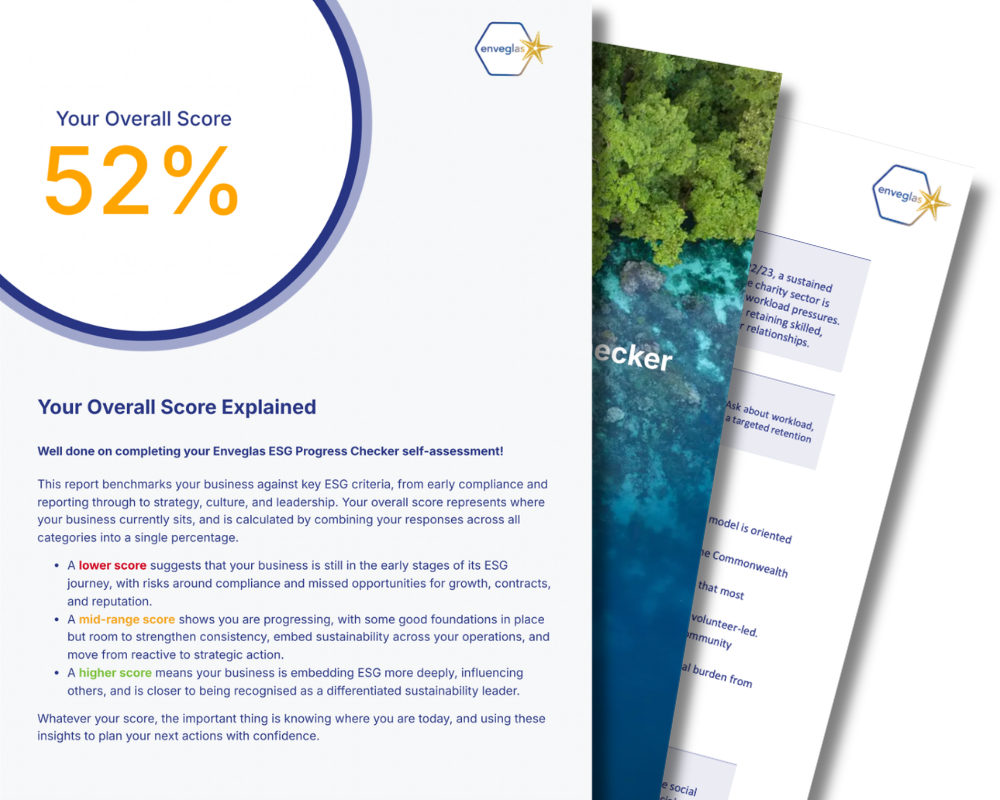
Enveglas ESG Progress Checker

Z

Indicative ESG score across the seven-step Sustainability Staircase

Z

A clear view of your three biggest priority areas

Z

A downloadable PDF report you can share with your leadership team

Z

A clear next step into the full Enveglas Diagnostic

Enveglas ESG Progress Checker report sample

Check out more of our FREE resources here!

What our clients are saying…

“Their support in establishing our GHG emissions baseline using the Greenhouse Gas Protocol was instrumental in driving a 40% reduction in Scope 2 emissions and a 7.8% reduction in Scope 1 emissions.”

The P & M Group – Awarded Cold Chain Climate Champion 2023.

Joanne Swift

Group Sustainability Manager, The P & M Group

Manufacturing

A full Scope 1, 2 and 3 GHG emissions baseline

We measured CHH’s complete footprint across all three scopes, giving them the foundation to track progress and target reductions.

Facilities Management

Three years of complete emissions data

A full Scope 1, 2 and 3 baseline built out over three years, with Scope 3 coverage deepened each year for a clearer, more credible picture for Calabash.

Manufacturing

A 13.2% cut in their carbon footprint

With a full baseline in place, TDP measured a 13.2% reduction year on year, driven by their carbon reduction strategy.

Take the First Step Today…

Ready to understand your carbon impact and make meaningful reductions? Book your free consultation now!


Related Articles…

Frequently Asked Questions…

What is carbon accounting?
Carbon accounting is the process of measuring the greenhouse gas (GHG) emissions a business is responsible for, expressed in tonnes of carbon dioxide equivalent (CO2e). It covers Scope 1 (direct emissions), Scope 2 (purchased energy) and Scope 3 (value chain emissions). Wylde Connections calculates emissions to the GHG Protocol and turns the results into an audit-ready report and a reduction plan.
What is decarbonisation?

Decarbonisation is at the heart of building a sustainable future and achieving Net Zero ambitions. By reducing greenhouse gas (GHG) emissions across Scope 1, 2, and 3, businesses can mitigate climate risks, enhance operational efficiency, and meet regulatory compliance requirements such as SECR and ESOS. Our tailored approach ensures your organisation not only reduces its carbon footprint but also demonstrates sustainability credentials that meet the demands of supply chains and stakeholders.

What is the difference between Scope 1, 2 and 3 emissions?
Scope 1 is direct emissions from sources you own or control, such as gas heating and company vehicles. Scope 2 is indirect emissions from the energy you buy, mainly electricity. Scope 3 is all other indirect emissions across your value chain. Scope 3 is usually the largest part of a footprint, which is why every baseline we produce covers all three from the outset.
Do you offer a Scope 1 and 2 only baseline?
No. Every baseline we produce is a full Scope 1, 2 and 3 measurement. Scope 3 is usually the largest part of a footprint and the part that customers, tenders and PPN 006 Carbon Reduction Plans ask for. A Scope 1 and 2 only figure leaves that out, so it is neither complete nor defensible, and you would have to redo it as soon as Scope 3 is requested.
Do I need a Carbon Reduction Plan to bid for contracts?
Often, yes. Under PPN 006 (formerly PPN 06/21), a compliant Carbon Reduction Plan is a condition of bidding for many UK central government contracts above £5 million per year, and the requirement is increasingly applied by the NHS, local authorities and framework applications. A compliant plan must state a base year, cover Scope 1, Scope 2 and at least five Scope 3 categories, and confirm a commitment to Net Zero by 2050.
What is a GHG emissions baseline?
A GHG emissions baseline is your first complete measurement of emissions for a chosen base year. It becomes the reference point against which all future progress is measured, and it is the foundation for a Carbon Reduction Plan, SECR reporting and any reduction target. You cannot manage what you have not measured.
What is SECR and who has to comply?
Streamlined Energy and Carbon Reporting (SECR) requires large UK companies, quoted companies and LLPs to report their energy use, carbon emissions and an intensity ratio in their annual accounts. A company generally qualifies if it meets at least two of: 250 or more employees, turnover above £36 million, or a balance sheet total above £18 million.
What is ESOS Phase 4 and when is the deadline?
The Energy Savings Opportunity Scheme (ESOS) requires large UK organisations to carry out energy audits every four years. Phase 4 has a qualification date of 31 December 2026 and a compliance deadline of 5 December 2027. An organisation qualifies if it employs 250 or more people, or has turnover above £44 million and a balance sheet total above £38 million.
How long does calculating an emissions baseline take?
Because every baseline we produce is a full Scope 1, 2 and 3 measurement, the timeline depends mainly on your size, complexity and how readily available your data is. Data collection is usually the longest part, and we guide you through it with templates and support. We confirm a clear timeline in your proposal after the Discovery Call.
Who needs to be involved in the Carbon Calculation and Reporting process?

Who you need to involve will depend on the size of your business and the complexity of your data. You will need to involve staff from your Finance team to provide financial data from invoices. You may also need to involve Operations staff and members of your Procurement team if you have one. This can be decided at the initial Scoping Session.  

What information will I need to provide?
You will need access to your energy bills, fuel and mileage records for company vehicles, business travel and, for Scope 3, information on purchased goods and services, waste and commuting. Your Finance team usually provides spend and invoice data. If something is missing, we flag it and the plan recommends how to capture it.
How much does carbon reporting cost?

Our pricing is published and banded by size and complexity. 

Band 1, from £3,750: smaller, single-site service-based businesses with a straightforward value chain (up to around 25 employees). Your complete Scope 1, 2 and 3 baseline, report and reduction plan.

Band 2, £5,000: established SMEs with one to a few sites, product or service led (around 25 to 100 employees). As Foundations, with deeper data review and a fuller Scope 3 analysis.

Band 3, from £7,500: larger, multi-site, manufacturing or group structures with deep Scope 3 (100+ employees or group consolidation). As Standard, with multi-site or group consolidation and an expanded Scope 3 inventory.

Every band includes: a scoping session, data-gathering templates and support, a full Scope 1, 2 and 3 calculation (GHG Protocol, DEFRA factors), an audit-ready report with intensity ratios, a Carbon Reduction Plan with named owners, a consultancy session, and a Carbon+Alt+Delete software licence for ongoing tracking.

All prices exclude VAT. Your band is confirmed at the free Discovery Call, and we send a fixed proposal with no surprises.

How quickly can I see results from a Carbon Reduction Plan?

Results vary depending on your organisation’s size, industry, and current practices. Typically, clients begin to see measurable changes within 6 to 12 months of implementing a Carbon Reduction Plan. Early actions often include energy efficiency improvements and waste reduction initiatives.

What industries do you work with?

Our services are versatile, supporting a wide range of industries, including (but not limited to):

  • Manufacturing: Optimising processes to reduce emissions and energy consumption.
  • Construction: Implementing sustainable building practices and materials.
  • Professional Services: Enhancing operational efficiency and sustainability reporting.
  • Retail: Improving supply chain sustainability and reducing waste.
  • Transportation: Developing strategies for fuel efficiency and emissions reduction.
How do I get started?
Start with a free, no-obligation Discovery Call. We learn your goals and any compliance duties, agree the scope, and send a fixed proposal. Book using the widget on this page or call us on 01926 754061. If you would rather explore first, try the free Enveglas ESG Progress Checker.