Wylde Connections partners with University of Birmingham students to map sustainability impacts across the food and beverage value chain
26/06/2026
Five final-year students from the University of Birmingham have completed their dissertations in partnership with Wylde Connections, each researching a different stage of the food and beverage value chain. Together, Jemma, Jack, Zavier, Phoebe, and Amelia have produced something genuinely rare: a connected, evidence-based account of how the UK’s fast-moving consumer goods (FMCG) food and beverage sector creates environmental impact from the dairy farm to the recycling bin. For the students, the project offered real-world research experience at the sharp end of sustainability practice. For Wylde, the insight they have generated will directly shape how we support our clients in understanding and managing their own value chain impacts.
What is a value chain, and why does it matter for UK businesses?
A value chain covers the full journey of a product, from raw material extraction and primary production, through manufacturing, logistics, and retail, to use and end of life. For UK businesses, understanding that full journey is no longer a niche concern. Stakeholders, regulators, and supply chain partners increasingly expect organisations to account for impacts that reach well beyond their own factory walls.
Scope 3 emissions — the indirect greenhouse gas (GHG) emissions that arise across a company’s upstream and downstream value chain — are where the majority of most businesses’ environmental footprint sits. For food and beverage companies in particular, agricultural production, ingredient sourcing, distribution, and end-of-life disposal can dwarf direct operational emissions. Without visibility of the whole chain, any sustainability strategy is incomplete.
How did our partnership with the University of Birmingham come about?
At Wylde, value chain mapping sits at the heart of everything we do. We thrive on collaboration, and our relationship with the University of Birmingham goes back several years. We have been delivering value chain mapping workshops to their undergraduate students since 2022. This year, we wanted to take that partnership further.
We supported five final-year students on the Environmental Change and Sustainability degree, each researching a different stage of the value chain. In June, we gathered at the STEAMhouse Innovation Centre in Birmingham to hear their findings and we were hugely impressed. Jemma Payne-Cook examined primary production through the lens of UK dairy farming. Jack Manley analysed Scope 1 and 2 emissions in food and drink manufacturing. Zavier Sheikh investigated downstream transport and outbound logistics. Phoebe Hill assessed food waste in manufacturing and Amelia Spittle looked at what happens to packaging at end of life. Read together, their work is a forensic account of a sector that feeds the nation and an honest reckoning with the sustainability implications of doing so.

What did the research find? Five stages of the food and beverage value chain
Each researcher focused on a distinct stage of the supply chain, producing an account that, taken together, offers a whole-system view of where sustainability challenges in UK food and beverage production are most acute.
ESG issues in UK dairy farming
Jemma’s research examined the environmental, social, and governance (ESG) challenges facing UK milk production, focusing on animal housing and financial risk. She found that UK dairy cows are increasingly kept indoors year-round, with space allowances falling short of RSPCA guidance, disease risk rising, and grazing land lost to feed production. Financially, farm-gate prices have at times fallen below the cost of production, subsidies have not kept pace with inflation, and demand for cow’s milk is softening. Her recommendations are practical and farmer-centred: a partly fixed price floor, a rebalancing of the Sustainable Farming Incentive to better support livestock farmers, alignment of welfare guidelines with RSPCA standards, and greater use of young farming advocates to drive culture change.
Operational decoupling in food and beverage manufacturing
Jack’s dissertation asked whether UK food and beverage businesses are managing to reduce their environmental impact while continuing to grow. Analysing Scope 1 and 2 emissions, energy intensity, and water intensity across Greencore, Britvic, and AG Barr between 2018 and 2024, his headline finding was encouraging: all three achieved absolute decoupling of emissions from revenue growth. Yet each faced distinct constraints — Greencore’s 24/7 refrigeration demands, Britvic’s Brazilian supply chain challenges, and AG Barr’s complicated baseline following acquisitions. Jack also developed his own metric, carbon productivity, expressed as revenue generated per tonne of CO₂. A central concern throughout was the inconsistency of corporate disclosure, which made meaningful comparison between firms extremely difficult. His call for standardised reporting frameworks is one that Wylde echoes strongly.
Downstream transport and Scope 3 Category 9 emissions
Zavier’s research sat at a critical and often overlooked boundary in emissions accounting: the point at which goods leave the factory and enter the distribution network. Scope 3, Category 9 covers downstream transport and distribution emissions and represents a significant share of the sector’s total footprint, yet reporting in this area is voluntary, inconsistent, and frequently incomplete. Analysing data from Hilton Foods, Britvic, Pilgrim’s UK, Premier Foods, and AG Barr between 2019 and 2024, he found that decoupling of transport emissions from revenue and production growth did occur, but unevenly. His key finding highlights a risk familiar to Wylde’s practitioners: emissions can migrate between scopes, creating the appearance of progress in one area while the problem persists in another. Transparent, category-level reporting is the only reliable safeguard.
Food waste in UK manufacturing
Phoebe tackled food waste at the manufacturing stage, a part of the supply chain often overshadowed by consumer-facing statistics yet carrying significant embedded environmental and social cost. Working with WRAP data across 25 companies in six food categories, she found waste intensity ranging from zero to 12% of food handled — a range so wide it points to individual business motivation rather than sector-wide norms. Her findings challenged the food waste hierarchy as currently framed: useful as it is, it is purely environmental in focus, missing the social and economic value of food. Phoebe evaluated solutions from packaging innovation and date-label reform to valorisation of by-products such as whey and fish skins, concluding that prevention, redistribution, and valorisation must work together. That requires a boardroom commitment to sustainability that many businesses have yet to make.
Packaging recyclability and Extended Producer Responsibility
Amelia’s research examined the gap between policy-defined recyclability and what actually happens to food packaging in practice. She focused on three material types covered by the Extended Producer Responsibility (EPR) framework: paper and cardboard, glass, and plastic pots, tubs, and trays. All three received a Green rating under the Recyclability Assessment Methodology, suggesting they are collectable, sortable, and recyclable. Amelia’s own analysis, which incorporated supply chain losses at each stage of the recycling process, told a more complicated story. A Green rating is no guarantee of effective recycling in practice — infrastructure capacity, sorting system inefficiencies, and waste market dynamics all shape the actual outcome, and those factors are not fully reflected in the policy framework. For FMCG producers designing packaging strategy, this distinction matters enormously.
What does this research tell us about whole-system sustainability?
This project has reinforced something we know to be true at Wylde: without a whole-system view, sustainability strategies tackle symptoms rather than causes. Having five talented researchers map five successive stages of the same value chain has given us insight we simply could not have generated alone — and it will directly inform the tools and approaches we bring to our client work.
Engaging with students of this calibre is one of the most energising parts of what we do. All five are pursuing careers in sustainability or conservation, and every conversation has left us encouraged about the future of the field. We are grateful to the University of Birmingham, and in particular to Dr Mike Cassidy and the School of Geography, Earth and Environmental Sciences, for making this possible. Watch this space as we share more insights from their research over the coming weeks.
Ready to understand your value chain and strengthen your sustainability strategy?
Whether you are just starting to understand your value chain or looking to strengthen your sustainability reporting and strategy, Wylde Connections can help. Our services span ESG diagnostics, value chain mapping, GHG reporting, and green skills training — all designed to give businesses the clarity and confidence to act.
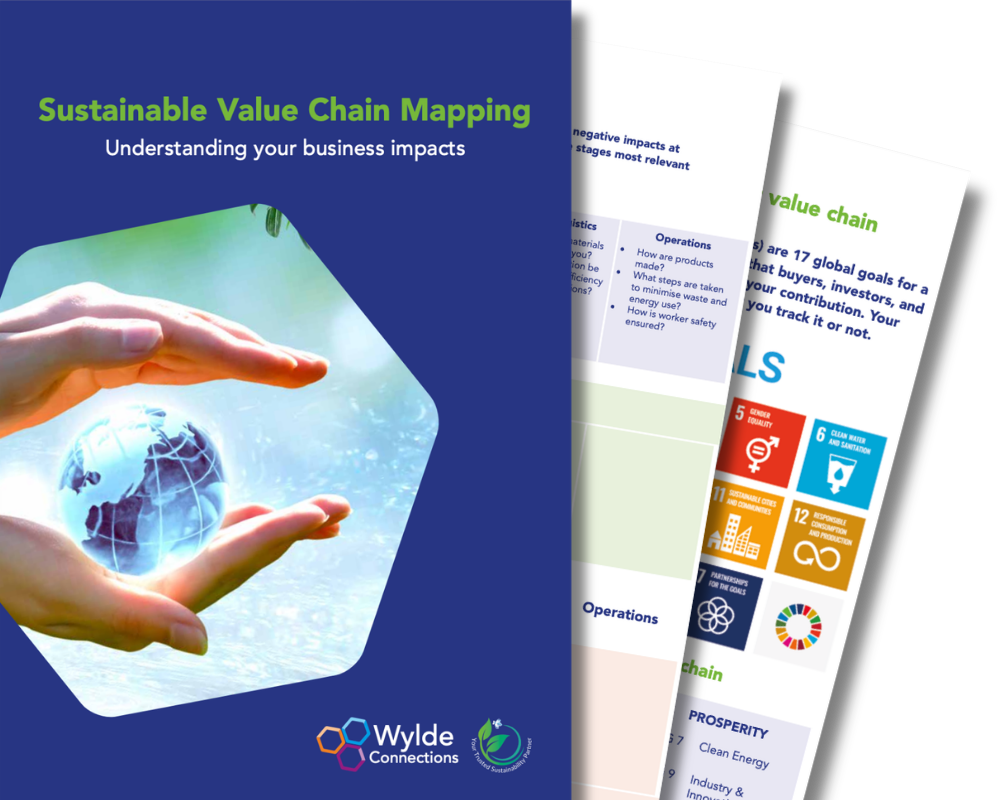
Try our FREE Guide to Sustainable Value Chain Mapping for UK SMEs
A practical guide to help small and medium-sized businesses map their impacts across the value chain and build credible ESG evidence.
Download the guide and start mapping the impacts that will shape your ESG questionnaire responses, tender bids and customer conversations.
Frequently Asked Questions: Value Chain Sustainability and Supply Chain Reporting
What is Value Chain Mapping, and why do UK businesses need it?
Value Chain Mapping is the process of identifying and analysing the environmental, social, and economic impacts that occur at each stage of a product’s lifecycle, from raw material extraction through to disposal or recycling. For UK businesses, particularly those in manufacturing, food production, or retail supply chains, it provides a structured way to understand where the most significant ESG risks and opportunities lie. It is increasingly required by customers, investors, and reporting frameworks including the Corporate Sustainability Reporting Directive (CSRD) and the UK Streamlined Energy and Carbon Reporting (SECR) regime.
What are Scope 3 emissions, and how do they relate to food and beverage businesses?
Scope 3 emissions are the indirect greenhouse gas (GHG) emissions that occur across a company’s value chain, both upstream — in the production of goods and services a business buys — and downstream — in the distribution, use, and disposal of products it sells. For food and beverage businesses, Scope 3 often represents the largest share of total emissions. It includes emissions from agricultural production, ingredient sourcing, outbound logistics, and end-of-life packaging. As this research demonstrates, reporting on Scope 3 remains voluntary in many categories, yet it is precisely where supply chain accountability and competitive differentiation are increasingly expected.
What is Extended Producer Responsibility (EPR), and how does it affect UK food businesses?
Extended Producer Responsibility (EPR) is a UK government policy framework that makes producers financially responsible for the end-of-life management of the packaging they place on the market. For food and beverage businesses, this means greater accountability for how their packaging is collected, sorted, and recycled. As Amelia’s research found, a Green recyclability rating under current methodology does not guarantee effective recycling in practice. Infrastructure capacity, sorting inefficiencies, and waste market conditions all affect actual outcomes — making EPR an increasingly complex compliance and strategy challenge for UK producers.
How can value chain mapping help my business reduce ESG risk and respond to supply chain demands?
Understanding your value chain gives you the evidence base to respond credibly to ESG questionnaires, tender requirements, and customer data requests. For manufacturers and food businesses facing increasing Scope 3 reporting expectations from large customers or public procurement frameworks, value chain mapping identifies where you are most exposed and where targeted action will have the greatest impact. It also strengthens your sustainability narrative with investors, lenders, and regulators. Wylde Connections supports businesses at every stage of this process, from initial impact identification through to GHG reporting and strategy development.