News & Blogposts
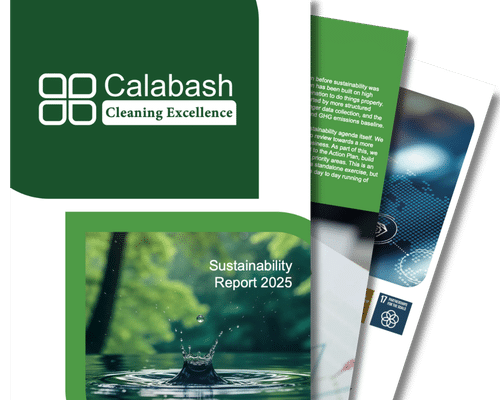
Built on Values, Backed by Evidence: Calabash Launches its 2025 Sustainability Report
01/05/2026
We are proud to have worked alongside Calabash, a UK facilities management business, throughout their sustainability journey. The publication of their 2025 Sustainability Report is a milestone that reflects real progress. This is not a business that arrived at sustainability as a response to external pressure. Calabash has always been driven by a straightforward belief that quality, fairness and responsibility belong together. Their refusal to use zero hours contracts, their commitment to the real Living Wage and their focus on lower impact cleaning products were in place long before anyone asked them to report on it. What we have helped them do is build the structure, the data and the strategy to turn those values into measurable, credible performance.
Calabash is a facilities management business operating in a sector where margins are tight, competition is fierce and clients are increasingly asking their service partners to demonstrate ESG credentials alongside operational excellence. That combination of commercial pressure and genuine values made Calabash a natural partner for us. From the outset, our work together has been guided by Wylde’s Five Step Model: Assess, Develop, Implement, Engage and Transform.
How Calabash built a credible sustainability evidence base
When Calabash first came to us, they already knew what they stood for. What they needed was a framework to prove it. The first step was to assess where Calabash stood. We conducted a strategic business review through a sustainability lens, mapping impacts across their operations and value chain. We helped them identify key impact areas, establish their baseline greenhouse gas emissions across Scopes 1, 2 and 3, and understand the environmental and social dimensions of their business in a structured way. That assessment gave Calabash the foundation it needed to move from good intentions to informed action.
From there, we worked together to develop a tailored sustainability strategy with clear priorities and an actionable plan. A double materiality assessment carried out by the senior management team identified the topics that matter most, both in terms of Calabash’s impact on people and the environment and the risks and opportunities those issues create for the business. Those priorities have been mapped against the United Nations Sustainable Development Goals and are now informing a focused and evidence based Action Plan.
Three years of emissions data, and what the numbers show
Calabash now has three years of greenhouse gas emissions data, and the latest figures reflect a much more complete picture of their Scope 3 footprint. Total reported emissions rose to 224.67 tCO2e for 2024/25, up from 163.69 tCO2e in 2023/24. That increase is driven by the inclusion of data that was previously only partially captured, particularly around purchased goods and services and waste from client sites. It is a sign of stronger reporting, not weaker performance. The business remains committed to reducing absolute emissions by 50% by 2030 against its baseline year, and the priority now is to continue improving data accuracy so that future reductions can be tracked credibly and targeted effectively.
Why social sustainability sets Calabash apart
What stands out most about Calabash is that social responsibility is not a secondary consideration. It is embedded in how the business operates. 99.3% of their sites now pay the London Living Wage, and at least 95% of employees are paid the Real Living Wage. Their pay equity ratio has improved to 0.998. They no longer accept contracts that do not meet Living Wage standards. They recorded zero accidents and zero near misses this year. And they recently achieved ISO 45001 certification, demonstrating that their commitment to protecting their people is backed by a recognised health and safety management system.
In a sector where low pay, insecure contracts and high staff turnover are common, Calabash has chosen a different path. That choice is not only the right thing to do. It is building a stronger, more resilient business. Higher retention, better motivated teams and a reputation for ethical practice are all contributing to competitive advantage.
What comes next: from reporting to transformation
The 2025 report is not the end of a process but provides a platform from which the business can accelerate progress. Calabash is now establishing a Sustainability Working Group to build ownership across the organisation and ensure sustainability is reflected in day to day decision making. They are moving towards quarterly sustainability progress reviews as part of their regular management meetings. Their work towards B Corp accreditation continues. And they are planning to expand the proportion of activity based data in their Scope 3 reporting, formalise supplier engagement on ESG, strengthen water efficiency practices and roll out structured sustainability training.
This is where the Engage and Transform stages of our Five Step Model come into their own. Having assessed, developed and begun to implement their strategy, Calabash is now focused on engaging stakeholders across the business and embedding sustainable practices into the culture for lasting impact. That progression from awareness to action to transformation is exactly the journey our model is designed to support.
As Denise Taylor, Managing Director at Wylde Connections, reflected: “What stands out most to me is that the social side of sustainability remains firmly at the heart of the business. Fair pay, workforce wellbeing, health and safety and respectful employment practice are not treated as secondary issues. They are part of the culture and values that shape how Calabash works. There is still more to do, but there is also real momentum, a clear sense of direction and a genuine commitment to keep moving forward.”
How Wylde Connections can help your business follow a similar path
The Calabash journey illustrates what becomes possible when a business commits to sustainability with the right structure and support. A robust strategy gives you clarity on where you stand, what your priorities are and how to demonstrate progress credibly to clients, investors and regulators. Better data gives you better decisions. Stronger social performance gives you a competitive edge. And a clear framework keeps the whole organisation moving in the same direction.
At Wylde Connections, we help UK businesses of all sizes build that foundation. Our Five Step Model of Assess, Develop, Implement, Engage and Transform provides a structured pathway from wherever you are today to where you need to be. Whether you are a facilities management business like Calabash, a manufacturer, a construction firm or a professional services company, the approach is the same: understand your impacts, build a credible strategy, implement it with measurable targets and communicate your progress with confidence.
If you are ready to start your sustainability journey or accelerate the progress you are already making, we would welcome the conversation. Book a free Discovery Call with our team and find out how the Wylde Five Step Model can help your business turn values into measurable, credible ESG performance.