Getting Rail Suppliers on Track to Demonstrate Their ESG Credentials
The pressure on rail supply chain businesses to report on their sustainability performance is intensifying. Clients, principal contractors, and infrastructure owners are increasingly expecting suppliers to provide evidence of their environmental, social, and governance (ESG) performance. Tenders are asking more challenging questions and contracts are including new requirements. The businesses that fail to access the right data are losing out to their competitors. How well does your business stand up to scrutiny?

That pressure was on full display at Rail Live 2026. Our team at Wylde Connections spent time with businesses across the sector to learn more about how sustainability is now far higher up the agenda. Be it innovative products that keep resources in the value chain, hearing discussions about embedding ESG in procurement, or showcasing nature positive practice, it was refreshing to see how the conversation has evolved.
Why is ESG scrutiny increasing across the rail sector?
Rail has always carried sustainability credentials as a mode of transport. Moving people and freight by train produces significantly less carbon than road or air, and that positioning has long been a point of pride for the sector. Yet the conversation has moved on. Buyers, clients, and regulators now want to see evidence that the businesses delivering rail infrastructure and services are themselves operating sustainably, from the emissions they generate to their employment practices and the social value they deliver.
Network Rail spends around £7 billion on goods, services, and works every year and expects all suppliers to support its ambition to deliver a simpler, better, and more sustainable railway. Its Greener Railway Strategy sets out its ambition to embed sustainability across every aspect of operations, from procurement and project delivery to supplier engagement. Suppliers who cannot demonstrate alignment with that agenda will increasingly find themselves on the wrong side of pre-qualification questions.
Alliance bidders on Network Rail contracts are expected to have credible carbon reduction plans, and social sustainability covering areas such as skills development, local small and medium-sized enterprise (SME) engagement, and diversity and inclusion. In essence, the supply chain must embed sustainability into both what it delivers and how it delivers it.
How will Great British Railways change rail procurement?
The arrival of Great British Railways (GBR) is reshaping the landscape of rail procurement. The Department for Transport has asked Network Rail to begin developing GBR’s Charges and Performance Schemes for Funding Period 1 (FP1), covering 2029 to 2034. This is the framework within which rail contracts will be awarded and managed for the next decade. Two thirds of GBR’s spending will flow through the supply chain, so achieving better outcomes requires close collaboration between Government, GBR, and industry as the detailed arrangements are developed.
With the majority of GBR’s investment flowing through supply chain businesses, the scrutiny applied to those businesses will only intensify as FP1 approaches. The Railways Bill requires the government to maintain a long-term rail strategy that includes environmental sustainability as one of its five strategic objectives. Sustainability is being written into the DNA of the new railway. Suppliers who have not yet built the evidence base to demonstrate their own ESG performance will struggle to compete for the work that FP1 will bring.
Why do rail suppliers struggle to evidence their ESG performance?
For many businesses in the rail supply chain, the challenge is not a lack of commitment to sustainability but an inability to demonstrate it. Businesses are often doing genuinely good things such as using resources more responsibly, supporting biodiversity, and engaging with local communities. However, when a tender asks for evidence of a structured ESG action plan, too many businesses struggle to respond.
This is a sector-wide problem. Tier 1s want to translate their sustainability ambitions into procurement objectives, and businesses are increasingly recognising that achieving their sustainability goals depends on the ESG performance of their suppliers. The pressure travels downstream in the chain. Those who are obliged to report on their ESG credentials, whether this is Scope 3 emissions or their social value and governance, need to obtain primary data from those suppliers. A business that cannot provide it becomes a liability rather than an asset.
How did Trough Tec Systems turn ESG into a competitive advantage?
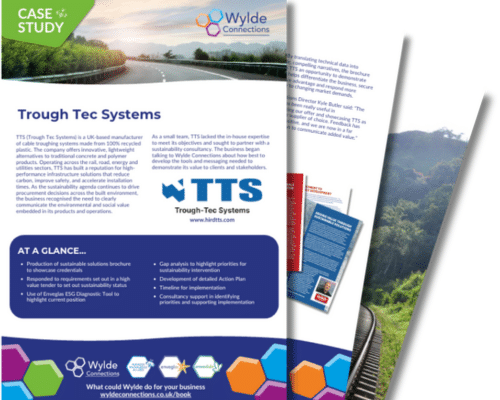
Trough Tec Systems (TTS), a UK manufacturer of cable troughing systems operating across rail, road, energy, and utilities, found itself facing exactly this challenge. The business had already embedded sustainable design principles into its products, which are made from 100% recycled plastic, yet when a significant infrastructure tender required detailed evidence of ESG performance, TTS did not know how to respond.
Working with Wylde Connections, TTS first developed a Sustainable Solutions document that translated its technical advantages into clear, accessible messaging for clients and procurement teams.
When a further tender required formal evidence of ESG performance across the business, TTS used Wylde’s Enveglas ESG Diagnostic Tool to baseline its current position, identify gaps, and produce a structured action plan. Enveglas assesses performance across five ESG categories, generating a report aligned with frameworks including the UN Sustainable Development Goals (SDGs), B Corp, and EcoVadis.
“I really enjoyed the process of going through the diagnostic. It got me excited about where we could take our business in terms of ESG, and the action plan and timeline will help guide our interventions. Receiving support from an experienced consultant made all the difference.
One thing that really impressed me about working with Wylde Connections was that their solutions are bespoke. They took the time to get to know our business and tailored their support to meet our specific needs. From the research I did, I didn’t feel we would get that from other consultancies.”
Kyle Butler, Operations Director at TTS.
The result? TTS used the Enveglas report to complete its tender application and was subsequently shortlisted for the next stage of the selection process. The business now has the foundations in place to continue building its ESG position as client expectations evolve. Read the full case study here.
How can Wylde Connections help rail suppliers demonstrate their ESG credentials?
Whether your business is responding to its first ESG questionnaire or preparing for the procurement requirements that FP1 will bring, Wylde Connections can help you understand what is being asked of you and build the evidence to meet it. We support businesses with ESG diagnostics through Enveglas, greenhouse gas (GHG) emissions baselining across all three scopes, gap analysis and structured action planning, sustainability strategy development, stakeholder engagement, and the communications tools needed to articulate your credentials clearly in tenders and client conversations.
The businesses that get their ESG evidence in order today will be the ones winning contracts tomorrow.
Ready to get your ESG evidence in order?
→ Try the FREE Enveglas ESG Progress Checker
→ Call us on 01926 754061
Frequently Asked Questions
What ESG requirements do rail suppliers need to meet?
Rail suppliers are increasingly asked to evidence their environmental, social, and governance (ESG) performance as part of tender and pre-qualification processes. Network Rail expects suppliers to align with its Greener Railway Strategy, and alliance bidders are expected to hold credible carbon reduction plans alongside social sustainability measures such as skills development, local SME engagement, and diversity and inclusion. In practice this means suppliers need structured, evidenced ESG data rather than general statements of intent.
What is Great British Railways and how will it affect suppliers?
Great British Railways (GBR) is the new public body being set up to run Britain’s railways, bringing track and train together under one organisation. Around two thirds of GBR’s spending is expected to flow through the supply chain, and its procurement framework for Funding Period 1 (FP1), covering 2029 to 2034, will shape how rail contracts are awarded for the next decade. Suppliers who can evidence their ESG performance will be better placed to compete for that work.
What is Scope 3 and why does it matter for rail suppliers?
Scope 3 covers the indirect greenhouse gas emissions that occur across a company’s value chain, including those generated by its suppliers. Because a large share of a Tier 1 contractor’s emissions sits in its supply chain, rail suppliers are increasingly asked to provide primary emissions data so their clients can report accurately. Suppliers that can supply this data become a stronger partner; those that cannot risk being seen as a liability.
How can a small rail supplier evidence its ESG performance?
A practical first step is to baseline your current position. Wylde’s Enveglas ESG Diagnostic Tool assesses performance across five ESG categories and produces a structured action plan aligned with recognised frameworks. Combined with a greenhouse gas (GHG) emissions baseline across all three scopes, this gives a rail supplier the evidence needed to respond confidently to tenders and demonstrate progress over time.