
News & Blogposts
An integrated approach to ESG reporting: how your business functions can work together
21/04/2026
Sustainability reporting is becoming more complex, more detailed and more demanding. Businesses are being asked to provide data that spans energy use, carbon emissions, workforce practices, governance structures, supply chain impacts and more. No single person or department can gather all of that information. Yet in many organisations, the responsibility still sits with one team or, worse, with no one in particular. The result is incomplete data, missed deadlines and a report that fails to reflect the reality of the business.
Getting ESG reporting right requires an integrated approach that draws on every part of the organisation. The regulations are already signalling this direction. SECR, ESOS, CSRD and the forthcoming UK Sustainability Reporting Standards are all expanding what businesses need to disclose and raising the bar on data quality. For larger organisations, compliance is becoming more demanding with every reporting cycle. But the pressure does not stop at their front door. As many of these frameworks require reporting across the entire value chain, businesses further down the supply chain are increasingly being asked to provide credible ESG data to their customers. Whether you are the one reporting or the one being asked to supply the data, the expectation is the same: accurate, verifiable information drawn from across your business.
The businesses that build that internal capability now will be better prepared, more competitive and more resilient as requirements tighten.
It starts at the top
None of this works without senior leadership commitment. ESG reporting requires time, resource and cross-functional coordination. If the board and senior management team do not champion it, people across the business will treat it as a low priority. Leaders need to set the expectation that sustainability data collection is part of everyone’s role, allocate the budget needed, and hold people accountable for delivering their contributions on time. This is not about adding bureaucracy. It is about recognising that sustainability performance is business performance, and that the data to evidence it must flow from every corner of the organisation.
CFOs are particularly well placed to lead the reporting effort. Their expertise in data integrity, compliance and financial governance provides exactly the rigour that ESG disclosures demand. As sustainability metrics become embedded in financial reporting, the CFO’s role extends naturally into overseeing how ESG data is collected, verified and presented. Finance teams also hold data that underpins both environmental and governance reporting: energy and fuel spend, waste disposal costs, travel expenditure and capital investment in sustainability improvements. Bringing finance in early means your ESG data has a credible commercial foundation, and that the business is better placed to understand how sustainability risks and opportunities translate into financial exposure.
Operations: where the environmental data lives
Operations teams sit at the heart of the business’s environmental footprint. Energy consumption, fuel use, waste volumes, water usage and production efficiency all fall within their remit. If you are working towards GHG emissions reporting under SECR or building a baseline for net zero, most of your Scope 1 and Scope 2 data will come from here. The practical ask is not complicated: monthly meter readings, fuel and fleet records, and a basic waste log. The challenge is embedding that habit so the data is clean and consistent, rather than being chased at year end.
Businesses with ISO 14001 certification will find they already have a solid foundation in place. The environmental management systems and compliance frameworks that underpin that accreditation generate much of the data that ESG reporting requires.
Procurement and supply chain
For many businesses, the largest share of environmental and social impact sits within the supply chain. Scope 3 emissions, which cover indirect emissions from purchased goods, services, logistics and more, often account for the vast majority of a company’s carbon footprint. Procurement teams need to gather ESG data from suppliers, assess supplier practices against codes of conduct and due diligence requirements, and feed that information into the wider reporting framework.
This team controls relationships with your suppliers, which means they are best placed to request supplier ESG questionnaires, track responses and flag gaps. The Extended Producer Responsibility regulations are already requiring closer collaboration between procurement, operations and finance on packaging data. That cross-functional habit is one worth building now, before more reporting requirements follow. Going beyond regulatory compliance, it is also about building a supply chain that is transparent, resilient and aligned with the organisation’s sustainability goals.
Health, safety, environment and quality
HSE and quality teams already operate within structured management systems and compliance frameworks, making them a natural fit for ESG data collection. They hold data on workplace safety, environmental incidents, waste management and regulatory compliance, much of which maps directly onto the social and environmental pillars of an ESG report. Where this function is well established, it provides a strong and reliable source of data that sustainability leads can draw on directly.
HR and people
The social pillar of ESG relies heavily on HR data. Workforce diversity, employee turnover, training hours, pay equity, health and safety records and community engagement activity are all social indicators that stakeholders and reporting frameworks increasingly ask about. HR teams often already collect this information for other purposes. The task is connecting it to the ESG reporting process so it is consistent, comparable year on year and linked to genuine business outcomes.
HR also plays a broader role in embedding sustainability into organisational culture, building green skills across the workforce and ensuring that sustainability features in leadership development. Businesses that invest in that capability will find the whole reporting process becomes more straightforward as awareness and accountability grow across the organisation.
The sustainability team: coordinators, not sole contributors
Where a dedicated sustainability or environmental management team exists, their role is less about doing all the work themselves and more about overseeing and coordinating the process. Think of them as the project managers of the reporting cycle. They set the data requirements for each function, manage timelines, quality-check submissions and ensure that everything is aligned to the wider sustainability strategy and the organisation’s materiality assessment. That clarity of ownership makes a significant difference to the quality and consistency of the data that comes back.
Sales, marketing and new product development
Sales and marketing teams need to ensure that the sustainability story the business tells externally is grounded in evidence and aligned with what is being reported. As regulators crack down on greenwashing, this function plays an increasingly important role in understanding customer expectations around ESG and ensuring that messaging supports commercial objectives without overpromising.
New product development teams influence environmental impact from the earliest stages of design. Material selection, energy efficiency, recyclability and end-of-life considerations all have reporting implications. Life cycle assessments and Environmental Product Declarations generate data that strengthens ESG disclosures and demonstrates a commitment to reducing impact through innovation.
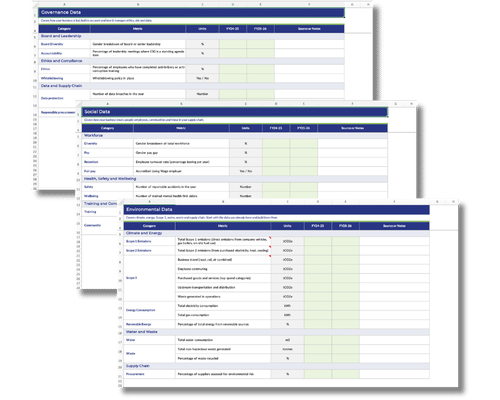
FREE ESG Data Collection Starter Template for UK SMEs
A practical starter template to help small and medium-sized businesses begin tracking the ESG data that matters
What good data collection looks like in practice
It does not need to be complicated. A shared data collection template, circulated to relevant function leads each quarter, with clearly defined responsibilities and simple instructions, will take you a long way. The key is agreeing in advance who owns what, so that when reporting season arrives, you are consolidating data rather than hunting for it.
Tools like the Enveglas ESG Diagnostic can help you understand exactly which data points matter for your business, where the gaps are and how to prioritise your data collection effort across functions. That structured baseline makes the whole process significantly more manageable and gives you a credible, audit-ready foundation to build from.
The bigger picture
When your functions work together on ESG data, something useful happens beyond better reporting. Operations spot efficiency savings. Finance quantifies sustainability risk. Procurement strengthens supplier relationships. HR improves staff engagement. Leadership gains a clearer picture of the business.
ESG reporting done well is not a compliance exercise. It is a way of seeing your business more clearly and making better decisions as a result.
A trusted partner for the whole organisation
At Wylde Connections, we work with businesses to build the skills, knowledge and capability needed across every function to support effective ESG reporting. From diagnostic tools like Enveglas that establish a clear baseline, through to consultancy, training and workshops that develop understanding at every level, we help organisations embed sustainability into the way they work, not bolt it on as an afterthought.
Whether you need to upskill your procurement team on supply chain due diligence, build your leadership team’s confidence in sustainability strategy, or develop a coordinated reporting framework that brings every department together, we can help.
Where to start
Not sure where your business stands on ESG? Our free Enveglas ESG Progress Checker gives you a quick, confidential snapshot of your current position across environmental, social and governance themes. It takes just a few minutes.
For a more comprehensive assessment, the full Enveglas ESG Diagnostic provides a detailed baseline across your business, with clear priority actions and the structured data you need for credible ESG reporting.
Or if you would like to talk through your ESG reporting requirements, book a free Discovery Call with one of our experienced sustainability consultants.