
News & Blogposts
Wylde supports businesses in navigating sustainability reporting and taxation
17/02/2026
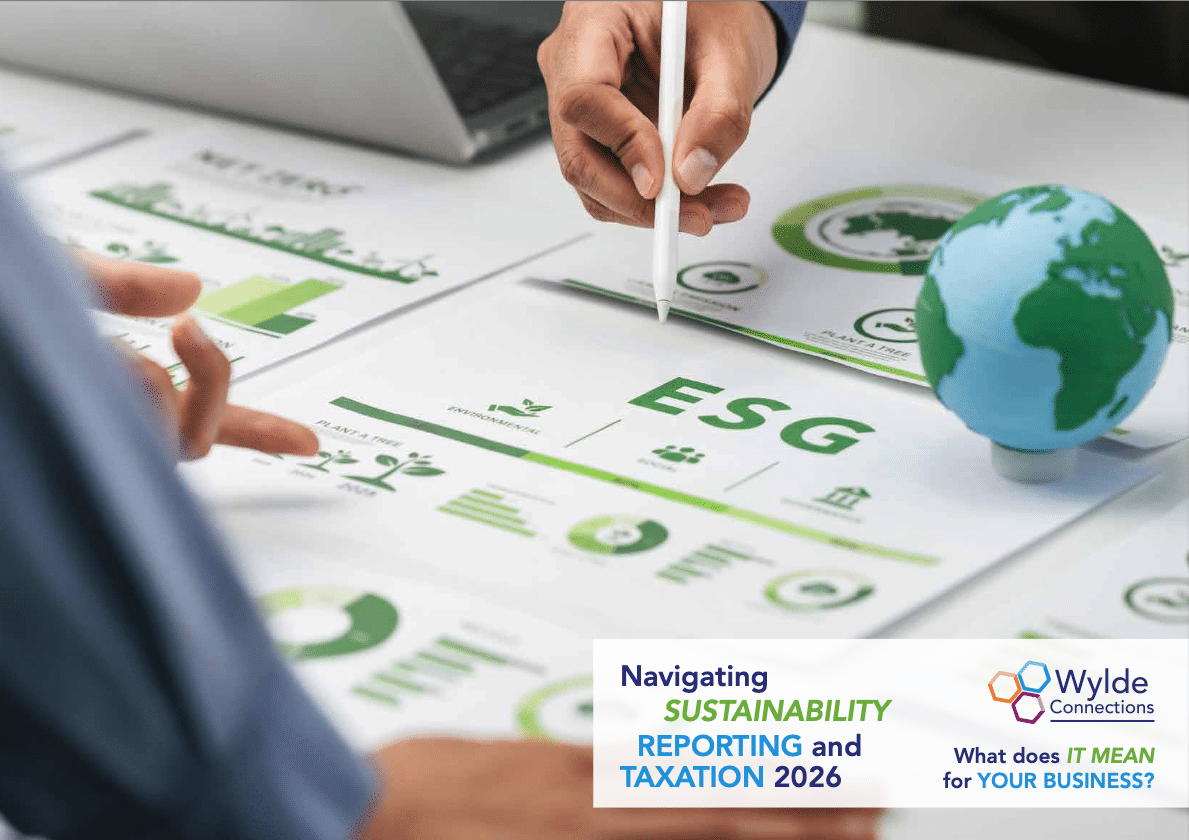
Sustainability reporting has entered a decisive new phase, and Wylde Connections has launched the latest edition of its flagship guidance, Navigating Sustainability Reporting and Taxation 2026, to help businesses respond with confidence.
The latest update reflects the rapid acceleration of regulation, rising expectations on transparency and the growing integration of environmental, social and governance (ESG) considerations into mainstream business practice. As reporting requirements become more detailed, assured and increasingly aligned with financial disclosure, the 2026 eBook provides a timely and practical overview of what is changing, who is affected and how organisations can prepare for the year ahead and beyond.
An evolving regulatory landscape
The direction of travel for sustainability reporting is now well established. What began as a focus on climate related disclosure for large companies is expanding rapidly across sectors, supply chains and geographies. UK policy developments, combined with European regulation and global reporting standards, are creating a more complex and demanding reporting environment for businesses of all sizes.
The forthcoming Sustainability Disclosure Requirements framework and the development of UK Sustainability Reporting Standards will extend disclosure expectations beyond climate alone. Businesses will increasingly be required to report on a broader range of sustainability issues using the principle of double materiality. This means demonstrating not only how sustainability risks and opportunities affect enterprise value, but also how business activities impact society and the environment.
Existing requirements are also evolving. Streamlined Energy and Carbon Reporting (SECR) is increasingly being used as a foundation for wider ESG disclosure and transition planning. ESOS Phase 4 strengthens the link between energy audits and action, introducing mandatory action plans and annual progress reporting. Climate related disclosures are being consolidated through IFRS S2, with rising expectations around governance, scenario analysis and quantitative metrics.
European regulation remains highly relevant. The Corporate Sustainability Reporting Directive (CSRD), Corporate Sustainability Due Diligence Directive (CSDD) and Carbon Border Adjustment Mechanism (CBAM) are all reshaping data requirements across value chains. Even where UK businesses are not directly in scope, many are being asked to provide reliable and verifiable sustainability data to support customer compliance.
Broadening the scope beyond climate
One of the most significant shifts reflected in the 2026 eBook is the growing emphasis on nature, biodiversity and social impact. Climate remains a central pillar of sustainability reporting, but it is no longer sufficient on its own. Investors, regulators and policymakers are increasingly recognising that biodiversity loss, ecosystem degradation and social inequality pose material risks to long term business resilience.
Nature related disclosures are moving rapidly up the agenda through the Taskforce on Nature related Financial Disclosures (TNFD). While TNFD reporting is not yet mandatory in the UK, it is shaping expectations and is likely to influence future reporting standards. The framework provides businesses with a structured way to understand their dependencies on nature, the impacts of their activities and the associated risks and opportunities.
Social disclosures are also maturing. Requirements around board diversity, workforce composition and human rights due diligence are becoming more established, particularly for listed companies and those operating across international supply chains. Together, these developments point to a future where sustainability reporting is broader, more integrated and more closely tied to business strategy.
Turning reporting into strategic value
While compliance remains an important driver, sustainability reporting should not be treated as a purely regulatory exercise. When approached strategically, it can strengthen governance, improve decision making and build trust with stakeholders.
Businesses that invest early in data quality, internal capability and structured processes are better positioned to respond to future regulation. They are also more likely to realise commercial benefits, including improved access to finance, stronger supply chain competitiveness, cost savings through efficiency and more effective risk management.
The 2026 eBook reinforces a simple but critical principle. Reporting is most effective when it forms part of a wider sustainability strategy. Data without direction offers limited value. Insight, prioritisation and action are what turn disclosure into meaningful progress.
Working with a trusted partner
Wylde Connections supports organisations at every stage of their sustainability journey. At the heart of this offer is the Enveglas ESG Diagnostic Tool, which provides a robust baseline across environmental, social and governance themes, identifying strengths, gaps and priority actions. From there, we work with clients through our structured Five Step Model to assess, develop, implement, engage and transform.
Whether you are preparing for new reporting requirements, responding to supply chain pressures or seeking to move beyond compliance towards genuine impact, our team provides the clarity, expertise and practical support needed to navigate the years ahead.
If you want to understand what sustainability reporting and taxation in 2026 means for your business and how to turn regulatory change into strategic opportunity, talk to us today and start building a future ready approach to sustainability.
Trackbacks/Pingbacks