Winning NHS Contracts: What the Evergreen Sustainable Supplier Assessment Means for Your Business
10/06/2026
The way businesses win public sector contracts is changing. Sustainability credentials are becoming as important as price and quality, and nowhere is this shift more visible than in the NHS.
The Evergreen Sustainable Supplier Assessment, introduced by NHS England in June 2023, is an online self-assessment and reporting framework that gives suppliers a standardised way to demonstrate their sustainability performance. From 6 April 2026, NHS Supply Chain requires all suppliers submitting tenders to have achieved Evergreen Level 1 as a minimum at the point of tender close. For suppliers already in the NHS ecosystem, or those hoping to enter it, understanding what Evergreen requires could make the difference between winning and losing contracts.
At Wylde Connections, we work with UK businesses every day who are navigating exactly this challenge. We have the tools, expertise and track record to help you get ahead.
Who Needs to Complete the Evergreen Sustainable Supplier Assessment?
Two categories of suppliers must complete the assessment:
- NHS Supply Chain Frameworks: Suppliers already on existing NHS Supply Chain Frameworks were required to submit the Evergreen Assessment by 1 February 2024. For any new NHS Supply Chain Framework, completion of the assessment forms part of the tendering process. There is no route around it.
- NHS England Medicines Tenders: All NHS England medicines tenders carried out by the Medicines Value and Access directorate require submission of the Evergreen Assessment. This requirement has been in place since January 2024.
Beyond these two categories, individual NHS trusts and integrated care boards (ICBs) can also reference Evergreen as part of their procurement processes. The expectation is that its use will continue to grow. Suppliers not yet required to complete it should be mindful that it may only be a matter of time.
What Does the Evergreen Sustainable Supplier Assessment Cover?
Evergreen assesses suppliers across four areas:
- Carbon emissions and net zero. This is the core of the assessment. It looks at whether you measure your carbon footprint across Scopes 1, 2 and 3, whether you have set a net zero target, whether you have published a Carbon Reduction Plan, and how you monitor and review your data over time.
- Environmental management. This covers whether sustainability is embedded into your day-to-day operations: your policies, governance structures, accountability frameworks, and how sustainability informs operational decision-making.
- Social value and responsible business. The NHS expects its suppliers to contribute to wider social outcomes, not just environmental ones. This section covers workforce wellbeing, equality, diversity and inclusion, ethical sourcing, responsible supply chain management, and modern slavery prevention.
- Monitoring and continuous improvement. This section looks at how you track performance, review data annually, and demonstrate measurable progress over time.
What Are the Evergreen Maturity Levels and What Do They Require?
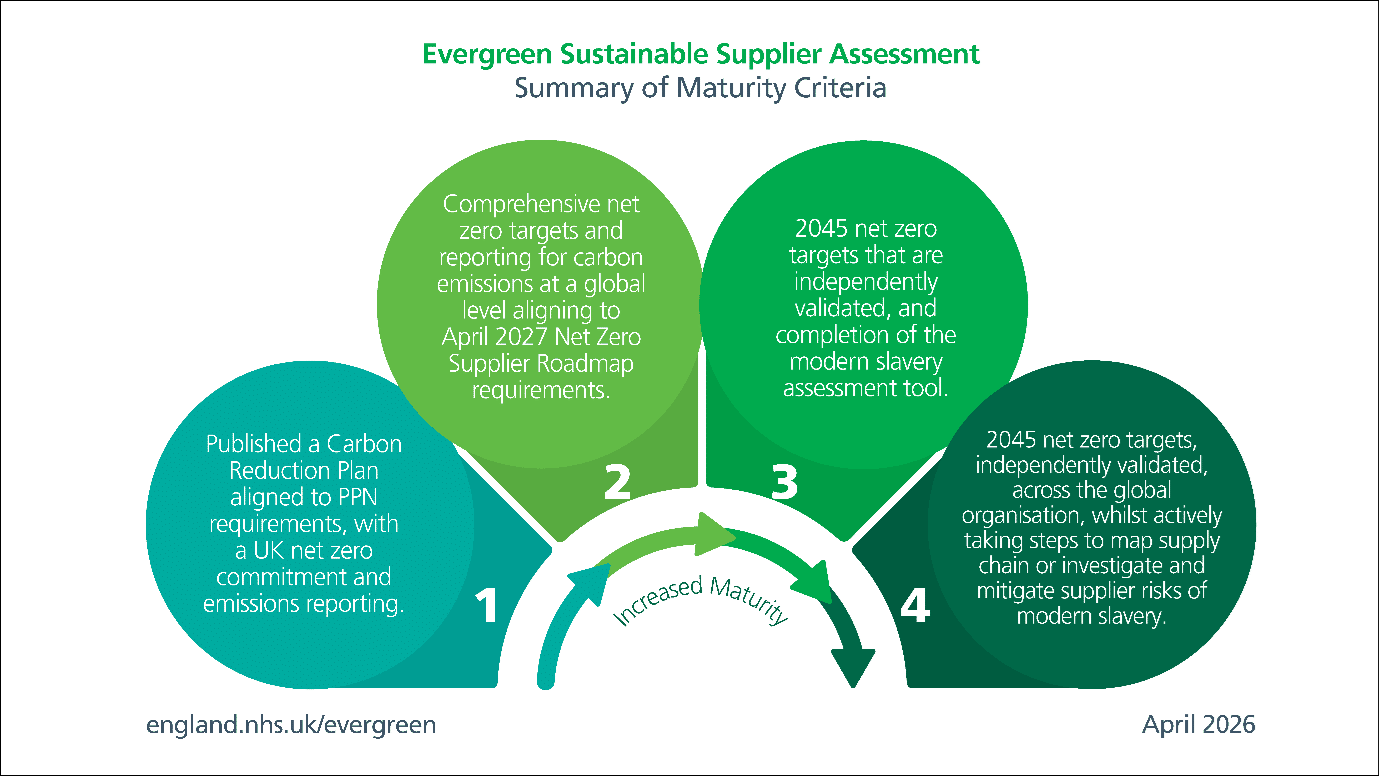
On completing the assessment, suppliers are placed at one of four maturity levels:
- Level 1 — Basic commitment: early-stage activity, initial carbon reporting, and a commitment to improve.
- Level 2 — Structured approach: stronger governance and more established sustainability reporting processes.
- Level 3 — Advanced maturity: independently validated net zero targets and more sophisticated integration of sustainability across the organisation.
- Level 4 — Leading practice: sustainability fully embedded into operations and strategy, with validated long-term targets and strong supply chain oversight.
Reaching Level 4 requires a 2045 global net zero target, independently validated, along with active steps to map your supply chain and identify modern slavery risks. Even Level 1 requires credible commitment, published data, and environmental measures already in effect.
The key point for suppliers is this: the assessment is not a tick-box exercise. Responses must be backed by evidence incorporating measured emissions data, a Carbon Reduction Plan, clear targets, and demonstrable progress. General statements of intent will not be sufficient.

How Long Does It Take to Prepare for the Evergreen Assessment?
One of the most important things to understand about Evergreen is that you cannot prepare for it overnight. To complete the assessment credibly, you typically need at least one full year of greenhouse gas (GHG) emissions data, a clear carbon baseline, a published Carbon Reduction Plan, and net zero targets aligned with NHS expectations.
The businesses that will perform well in NHS procurement over the next three to five years are the ones building that data foundation now, rather than when a tender lands on their desk.
How Can Wylde Connections Help NHS Suppliers Prepare for Evergreen?
This is exactly where Wylde Connections comes in. We support UK businesses across all sectors to understand their ESG position, build credible sustainability strategies, and produce the evidence needed to demonstrate progress to customers, commissioners and supply chains.
At the heart of our offer is the Enveglas ESG Diagnostic Tool. Enveglas gives businesses a clear and comprehensive baseline across all the areas the Evergreen assessment covers: environmental performance, social value, governance, and carbon emissions. It identifies your strengths, highlights your gaps, and gives you a robust action plan to help you on your journey.
Following the diagnostic, our team supports clients through our structured Five Step Model of Assess, Develop, Implement, Engage and Transform. We turn the findings from Enveglas into a practical sustainability strategy with clear goals, measurable milestones, and the reporting frameworks needed to evidence progress. Our experienced consultants support you with GHG emissions baselining across Scopes 1, 2 and 3, Carbon Reduction Plan development, sustainability reporting, and supply chain engagement.
We also offer training and workshops to build sustainability capability within your team and embed best practice. The businesses that engage with us early consistently find that the outputs have value well beyond a single procurement process. A strong ESG position helps respond to customer questionnaires, strengthen tender submissions across other procurement frameworks, and build confidence with your own supply chain.
If you supply to the NHS or hope to do so, the best starting point is a clear picture of where you stand right now. The procurement landscape is changing. The NHS is leading that change. The businesses that prepare now will be the ones with the competitive advantage when the next tender lands.
Ready to find out where your business stands on Evergreen readiness?
Frequently Asked Questions…
Is the Evergreen Sustainable Supplier Assessment mandatory for all NHS suppliers?
Not universally, but the scope is broad and growing. From 6 April 2026, all suppliers submitting tenders to NHS Supply Chain must have achieved Evergreen Level 1 at the point of tender close. Suppliers on existing NHS Supply Chain Frameworks were required to submit by 1 February 2024. All NHS England medicines tenders have required submission since January 2024. Beyond these categories, individual NHS trusts and integrated care boards (ICBs) can also reference Evergreen in their procurement processes. If you supply to the NHS in any capacity, it is worth treating Evergreen as a current or near-term requirement rather than a future consideration.
What evidence do I need to complete the Evergreen assessment?
Responses must be backed by documentation, not statements of intent. At a minimum you will typically need: measured greenhouse gas emissions data across Scopes 1, 2 and 3; a published Carbon Reduction Plan; evidence of environmental governance and sustainability policies; and documented processes for monitoring and reviewing progress. General commitments without supporting data will not be sufficient to achieve a credible maturity level.
How long does it take to prepare for the Evergreen assessment?
Building a credible evidence base takes time. At minimum you need at least one full year of GHG emissions data, which means businesses that have not yet started their carbon baselining should begin immediately. Depending on your starting point, developing the governance structures, Carbon Reduction Plan and reporting frameworks needed to support a strong submission can take six to eighteen months. The businesses that perform well in NHS procurement are those that build this foundation before a tender arrives, not after.
What is a Carbon Reduction Plan and do I need one for Evergreen?
A Carbon Reduction Plan (CRP) is a document that sets out your current greenhouse gas emissions baseline across Scopes 1, 2 and 3, your net zero target, and the actions you are taking to reduce emissions over time. Yes, a Carbon Reduction Plan is required for the Evergreen assessment. It is also required for certain public sector procurement frameworks, including PPN 06/21. A well-structured CRP produced now will have value across multiple procurement processes, not just NHS-related ones.
What is the difference between Evergreen Level 1 and Level 4?
Level 1 represents basic commitment: early-stage activity, initial carbon reporting, and a demonstrable intention to improve. It is the minimum threshold for NHS Supply Chain tenders from April 2026. Level 4 represents leading practice: sustainability fully embedded into operations and strategy, with a 2045 global net zero target that has been independently validated, active supply chain mapping, and robust modern slavery risk management. Most suppliers currently entering the assessment will be working towards Level 1 or Level 2, with higher levels representing a longer-term ambition.
We only have Scope 1 and 2 emissions data. Is that sufficient for Evergreen?
Scope 3 emissions are part of the Evergreen assessment, so a Scope 1 and 2 only baseline is unlikely to be sufficient for a credible submission. Scope 3 covers all indirect emissions in your value chain — purchased goods and services, business travel, waste, and supply chain activity. For many businesses, Scope 3 represents the majority of their carbon footprint. At Wylde Connections, we do not offer partial baselines. Our GHG reporting service covers Scopes 1, 2 and 3 as a complete exercise, producing the evidence base you need for Evergreen and for any other customer, tender or regulatory requirement.